Chicago: An Operational Challenge
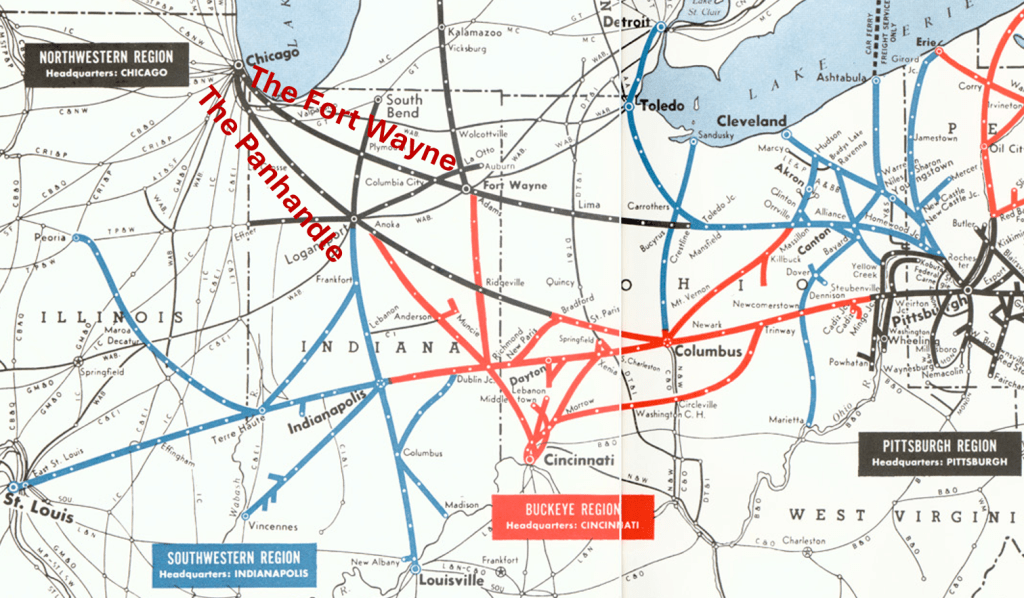
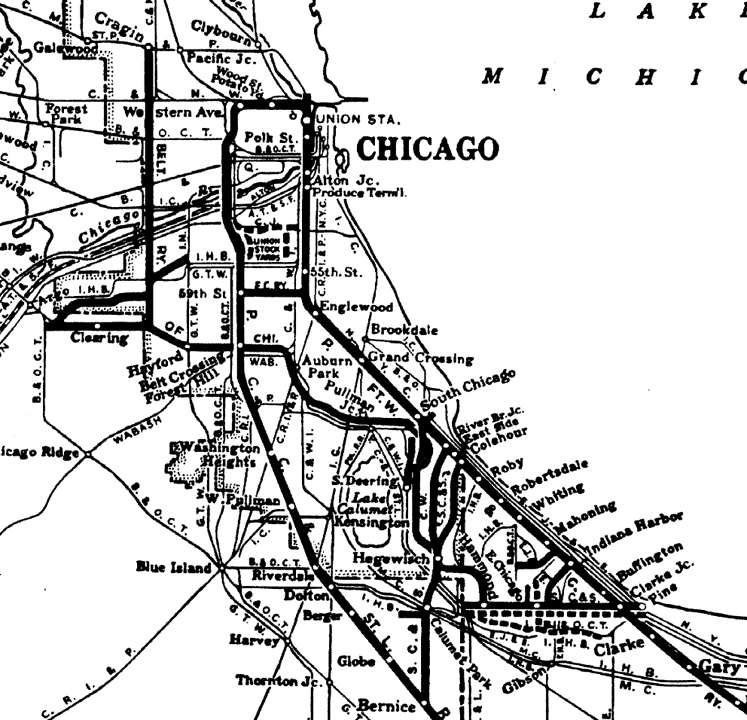
Created from two separate railroads, the Pennsylvania’s Chicago network lacked a single main classification yard. In early years of the 20th century, Robey Yard on the Panhandle west of downtown originated many trains. (Note: “Roby” is also used on some PRR documents; The Pennsy in Chicago by Edward DeRouin refers to it as “Damen Street Yard” after the new name of Robey Street and in later years some railroad documents also use this name.) By the end of the 1920s, most trains originated at the former Fort Wayne 55th Street Yard or the Panhandle 59th Street Yard, mostly based on which route the train would use leaving Chicago. Also, Chicago’s large industrial base, large outbound downtown merchandise traffic, and myriad interchanges generated carloadings at several other locations to be dealt with. Over the next 50 years, several different strategies would be used to try to solve this puzzle of how to efficiently get cars from a variety of origins to points east. The changing eastbound freight trains on the Panhandle tell part of this story.
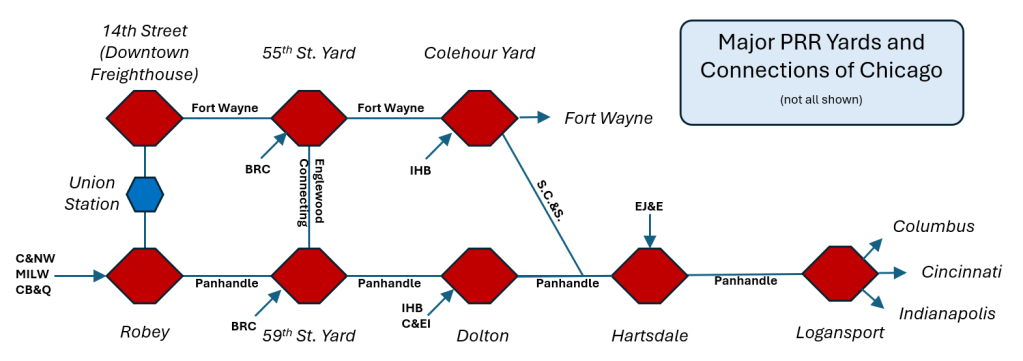
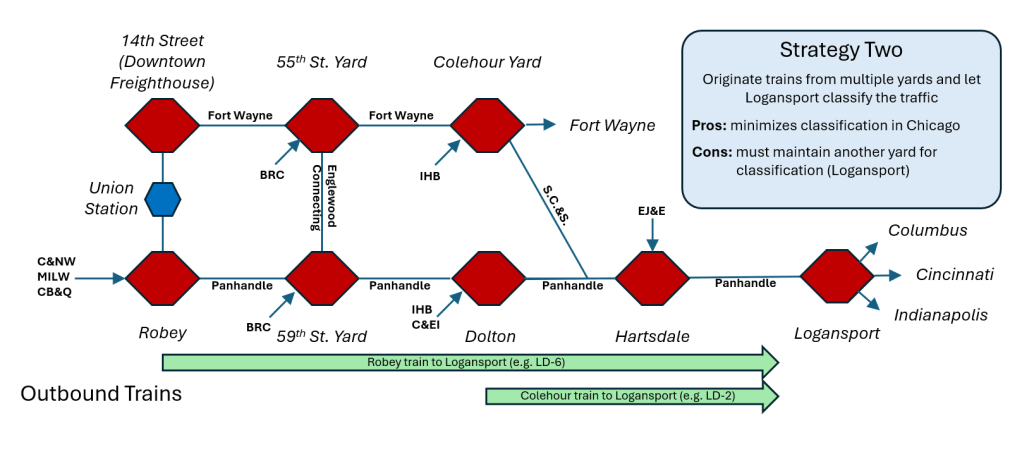
To tackle the problem, different strategies to get cars out of Chicago were employed. At any given time, a combination of each was used, but each strategy was more or less in favor during different eras.

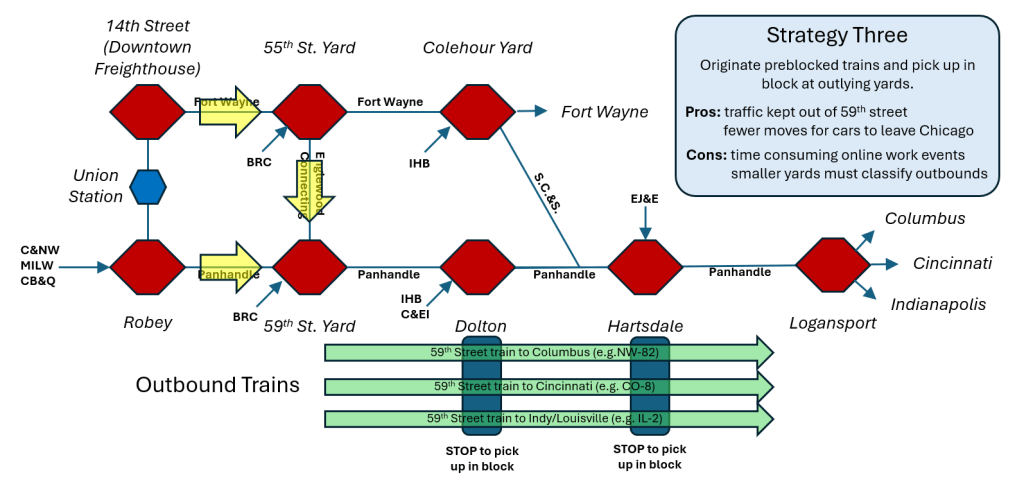
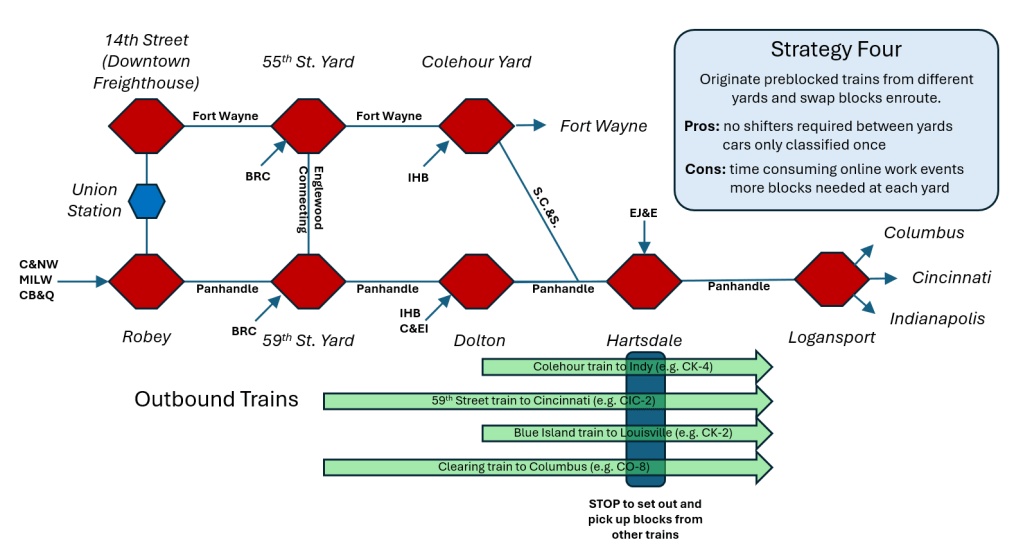
Arranged Freight Train Service Begins
Unfortunately, I don’t have access to much information from the 1920’s or earlier. This was a decade that would entrench operating patterns for decades to come. From The Railroad Freight Service published in 1926, p. 111:
The Pennsylvania Railroad some years ago established a working book or fast freight service and later it was reorganized into a preference freight service which gave preference to perishable products, LCL merchandise, and some of the higher classes of traffic and provided fast scheduled freight trains… Still later this railroad company adopted a comprehensive arranged freight service plan similar to [the New Haven].
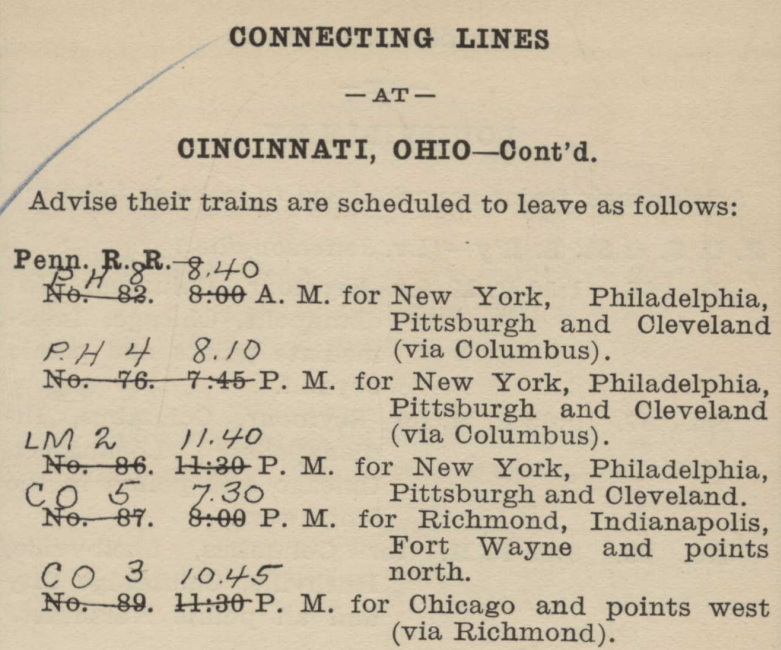
I’m not sure when the Pennsylvania began using its symbol naming system. An interesting clue is found in a 1909 L&N freight schedule: handwritten changes from train numbers to symbols. There is no way to know when these notes were written, but it does suggest the change happened sometime soon after 1909. While the trains from Cincinnati were changed, the train numbers for the Louisville connections remained at least through 1924. The 1924 schedule does show CO-5 listed as a side note. Did symbols and train numbers exist together for a decade or more on the Panhandle? I would like to see some confirmation from another source.
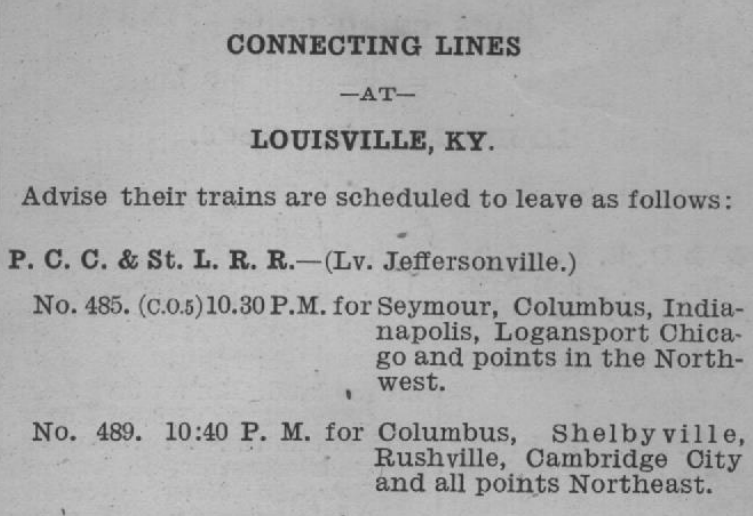
The earliest Pennsy timetable reference I’ve found to Arranged Service freight trains is from 1921. The Railroad Freight Service footnotes an Eastern Region Arranged Freight Service General Notice dated March 15, 1922 as a source. In April 1925, the Pennsy started the tradition of naming their primary freight trains which continued until at least 1960. How often these names were used in every day operations is unclear.
An August 1927 The Mutual Magazine article printed a list of named trains which Susan Yosten kindly posted to the PRR Groups.io board. Eastbound Panhandle trains included:
CO-6 “The Colonel”, Chicago to Louisville
CO-8 “The Invincible”, Chicago to Cincinnati
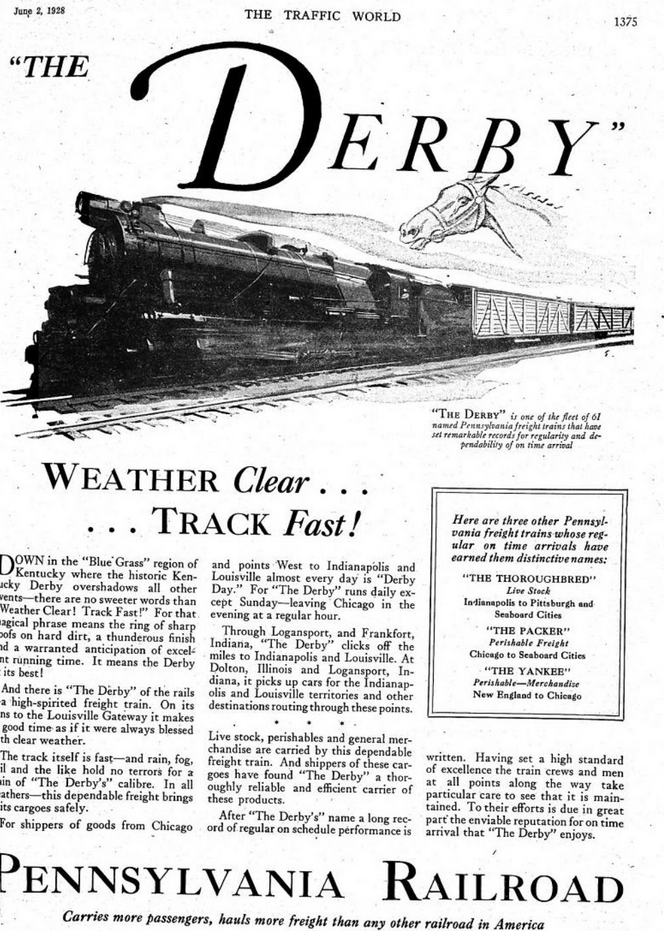
IL-2 “The Derby”, Chicago to Indianapolis
NW-84 “The Virginian”, Chicago to Columbus
NW-86 “The Reliable”, Chicago to Columbus
Interestingly, while The Mutual shows IL-2 “The Derby” as a Chicago to Indianapolis train, the advertisement above describes it as bound for Louisville, more appropriate for its name. It may have changed termination points between 1927 and 1928, it may have terminated in Indianapolis but carried a Louisville block, or one source is incorrect.
The only clues as to operating strategies employed in this era are provided by the 1929 Local Freight Schedules published by Ruth Gardner, and they aren’t clear. LD-5 is scheduled as a Robey Yard to Logansport train, also picking up at Hartsdale and La Crosse, with traffic for Logansport. Was this train taking traffic from connections at Robey for Logansport to classify? There was another local scheduled (LD-4) between Hartsdale and Logansport to do online local work, so LD-6 appears to be a through train. LD-2, a symbol that will last into the Penn Central years, looks to be a “gathering” train for Logansport during this era. Originating at 59th Street, it picked up at Washington Heights, Dolton, Bernice, Hartsdale, and North Judson, for Logansport, including livestock and perishables. In future years, LD-2 will become the Colehour connection to Logansport.
Based on the above evidence, it suggests the strategy most employed is “get it out of town” to Logansport, with most originating locations having a direct train connection to Logansport. It isn’t clear how Colehour area traffic moved, but this could have been moved to Bernice for LD-2 to pick up. There were also twice daily transfers between 59th Street and Dolton, so Dolton originating traffic may have been classified at 59th Street besides being picked up by LD-2.
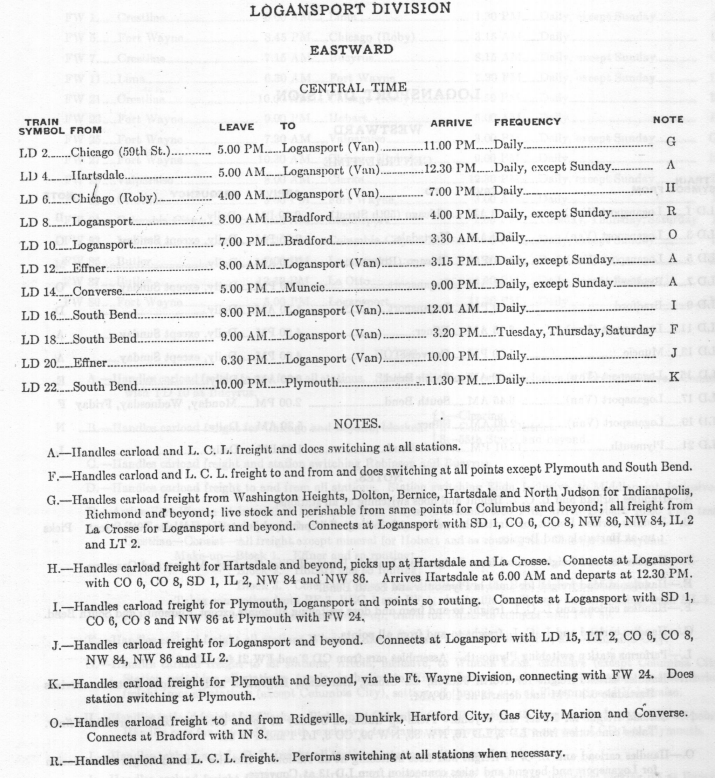
Symbol Naming Conventions 1920s – 1950s
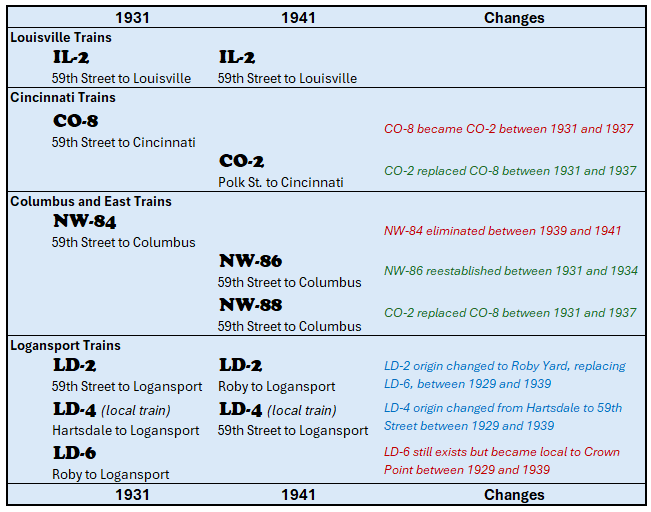
During this era, the symbols were pretty consistent, especially for eastbounds on the Panhandle. NW symbols (reportedly NW represents “Northwestern Division”) were trains to Columbus or beyond. IL was for Louisville trains, and CO was for Cincinnati trains. The CO symbols aren’t as clear cut, however. Westbound CO-5 variously originated at Louisville, Indianapolis, or Logansport, breaking the convention for “CO” representing Cincinnati trains. And in the 1927 Named Trains list, CO-6 was a Louisville train. But from 1931 onwards, eastbound Panhandle trains from Chicago remained consistent. IL means towards Indianapolis and Louisville, CO towards Cincinnati, and NW towards Columbus. [Interesting side note: in Penn Central years, the longtime CO-8 symbol continued to run but would become the Columbus train. I’m curious whether that was an error of not knowing the history (“CO” looks like it’d represent Columbus on first glance) or an intentional change.]
The Depression Hits
By 1931, IL-2 “The Derby” now runs beyond Indianapolis to Louisville, and the CO-6 “The Colonel” has become a Logansport to Louisville train. NW-86 has disappeared from the schedule, possibly a victim of the Depression. By 1936, three “NW” symbols will be operated; unfortunately I don’t have any further information about this brief period of only one “NW” train. It will be 1966 or 1967 before there will again be only one “NW” symbol on the Panhandle.
Each outbound train was scheduled to pick up any livestock or perishables at Dolton in block. Nonperishable carload traffic from Dolton was probably handled by LD-2 and/or transfers to 59th Street.
Sometime between 1931 and 1937, big changes come to the Panhandle. Gone (for now) is CO-8, replaced by a new symbol with no name, CO-2. But this is no average train. CO-2 is a hot evening departure from 16th Street yard downtown with the day’s outbound Polk Street merchandise for all Panhandle destinations. This train probably took the usual passenger train route via 55th Street and the SC&S to Bernice. CO-2 was the Panhandle’s answer to the Fort Wayne’s more famous LCL-2 cousin (though at this time WS-4 “The Mercury” was the eastbound Chicago merchandise train; LCL-2 hadn’t been extended to Chicago yet.)
The Logansport Merchandise Shuffle in 1941
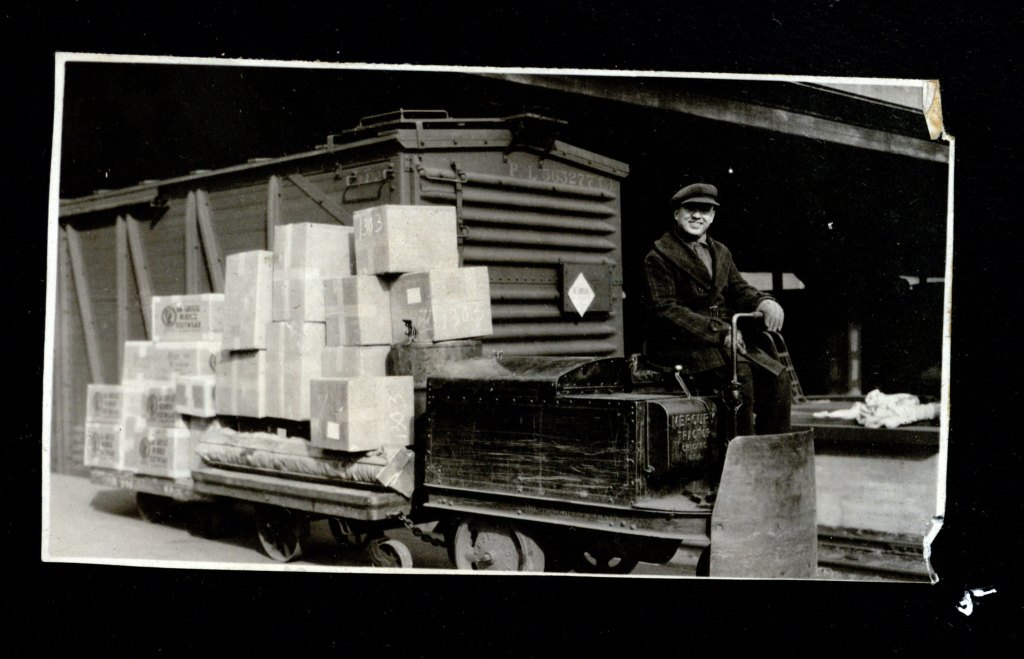
While most slept, each night a hurried swap of merchandise cars between trains happened at Logansport. Hot merchandise train CO-2 with the day’s pulls from Polk Street arrived at 9:45pm. Almost all of the merchandise cars were set off for other trains, and Cincinnati bound cars from inbound connections replaced them. But this must be done quickly; CO-2 still had Cincinnati merchandise for a 7:00am arrival. So CO-2 was scheduled to depart by 11:30pm.
Right behind CO-2 was IL-2 from 59th Street, arriving at 10:40pm. It would pick up the Indianapolis and Louisville merchandise from CO-2 and depart on its heels at midnight for a 6:00am arrival in Louisville.
Following IL-2 at 1:15am was CO-8, at this time a Logansport to Cincinnati train. While CO-2 had the Richmond and Cincinnati merchandise, CO-8 handled merchandise for Kokomo and Anderson so CO-2 would not be delayed working those points.
One mystery is the Columbus merchandise. CO-2 carries a block of it but does not show a connection at Logansport for it. NW-88 for Columbus was scheduled to depart at 9:40pm, a mere five minutes before CO-2’s arrival. Did NW-88 actually depart later with the Columbus merchandise in tow? Or did the following day’s NW-86 take the cars for a second morning arrival? A Merchandise Service Directory from this era would be interesting to answer this question.
By pulling the outbound merchandise directly from Polk Street to Logansport to make further connections, the Pennsy was able to offer overnight merchandise service from Chicago to Indianapolis, Louisville, Cincinnati, and possibly Columbus.
The CG’s Join the Fleet
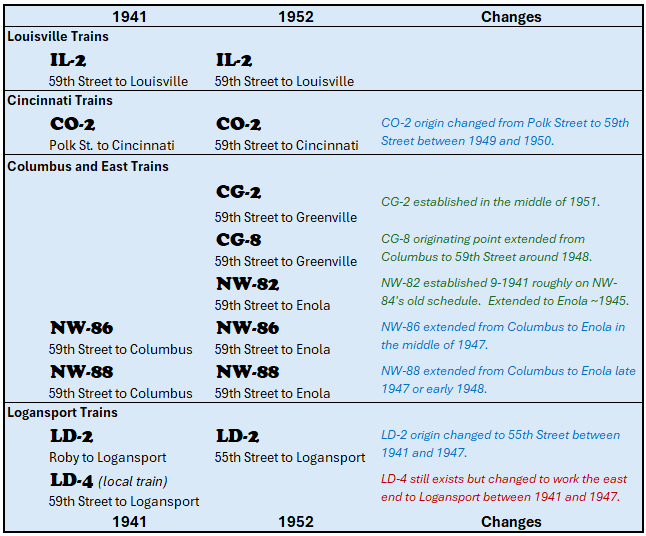
Around 1948, a new symbol joined the eastbound fleet from Chicago: the hot perishable train CG-8. This train was initiated around 1942 between Columbus and Greenville. Around 1948, CG-8 was extended to originate at 59th street to focus on improving perishable traffic performance from western connections to the Northeast.
Expand to read more about CG-8 and 365 days of on time performance in 1949-1950
February 16, 1950
TO EMPLOYES OF THE CHICAGO, COLUMBUS, PANHANDLE, PITTSBURGH, MIDDLE
PHILADELPHIA AND NEW YORK DIVISIONS.
When CG-8 rolled into Greenville (Jersey City) on the morning of
January 29th it was the 365th consecutive day that this remarkable train had
reached its destination in time to make the advertised connection with the
New Haven Railroad. For a whole year, day after day, this train wrote a
new chapter in railroad history and set an example of what we can accomplish
with other trains if we put all of our energies into the task.
CG-8 (Chicago-Greenville) is a “perishable” train carrying meats,
meat products, fruits and vegetables from the Pacific Coast, the Mountain
States, the Midwest and Chicago destined to the New York district and to New
England. Most of CG-8’s cars are received from western connections or
originate in Chicago. After the train leaves Chicago it is lengthened by
blocks of cars picked up at Logansport from the Effner gateway and from its
Wabash Railroad connection, and at Columbus from the St. Louis gateway. This
train also handles cars destined to points on the Norfolk & Western Railway
through interchange at Columbus.
CG-8 leaves Chicago at 8:30 P.M. It picks up the Effner connection
and departs from Logansport at 1:50 A.M. It completes its setoff and pickup
at Columbus by 9:45 A.M., is relayed through Pitcairn at 4:00 P.M. and departs
from Altoona at 8:30 P.M. after having set off a few cars. Diesel-electric
power which has brought the train from Chicago is replaced by electric motors
at Enola. Out of Enola at 1:30 A.M. it reaches Greenville at 7:00 A.M. after
having dropped part of the train, just short of Greenville, at Waverly Yard
where cars are subsequently distributed to the Newark-Jersey City-New York
area.
The portion of the train that goes into Greenville is floated across
the Hudson River to connections with the Long Island or the New Haven Railroads.
This latter group of cars is of the utmost importance because of the intense
competition that exists between the Pennsylvania, the New York Central and the
Erie Railroad for New England perishable traffic.
About a year ago it became evident that the only way the Pennsylvania
could retain the perishable freight from western connections was to do a better
job than the other railroads in making delivery to New York and to New England.
The decision was to concentrate our efforts on CG-8. The results have been most
gratifying. Again and again we have taken business from competing railroads
and from the trucks until it is now commonplace for CG-8 to have enough cars to
require its running in two sections on Fridays and Saturdays. It has gradually
brought the Pennsylvania to the forefront in this very important “cross country
business”.
We put our best power in front of this train; our best supervision
behind it. But that was as far as management could go. The real job has
been done by the men on the firing line, the enginemen and firemen, conductors
and brakemen, block operators, inspectors, trackmen and others who have taken
an increasing interest in getting this “hot shot” over the railroad. It has
become their pride and joy. The conductors are alert to take advantage of
every opportunity to keep CG-8 moving and avoid delay. At every curve
conductors and brakemen peer ahead for telltale signs of a hot box. Train
dispatchers, movement directors and block operators keep themselves posted of
the thundering progress of this valuable train and arrange to have a clear track
for CG-8. As it pulls into terminals for setoffs, pickups or relaying, the
car inspectors are vigilant in their detection of any condition that might
result in a mechanical failure somewhere on the road. Trackmen put an extra
pull on the wrench to make sure the railroad will be safe for CG-8. Yard
masters, signalmen and hostlers do their part. Every crossing watchman knows
when CG-8 is due, gets his gates down well in advance and looks for loose
rigging or sticking brakes as the train passes his post. He lifts his gate
with one hand, waves to the disappearing brakeman with the other. “There she
goes, on time again!”
The only way that CG-8 could have put on this outstanding performance
has been through the wholehearted interest and enthusiasm of thousands of employes. You can be very proud of CG-8 for it is truly your train. We are confident that you will keep it rolling.
We who are responsible for the operation of the three Regions through
which this train passes are taking this means of expressing our appreciation
for the hard work and genuine enthusiasm that you fellow employes have shown
in compiling this record for CG-8. It means better service by the Pennsylvania
Railroad. That in turn means more business for the Company and more work for
more employes. It is a remarkable illustration of what can be accomplished
when everyone involved becomes enthusiastic and puts his shoulder to the wheel.
You are undertaking an important job and doing it well.
(From 1948 Annual Report found on Streamliner Memories)
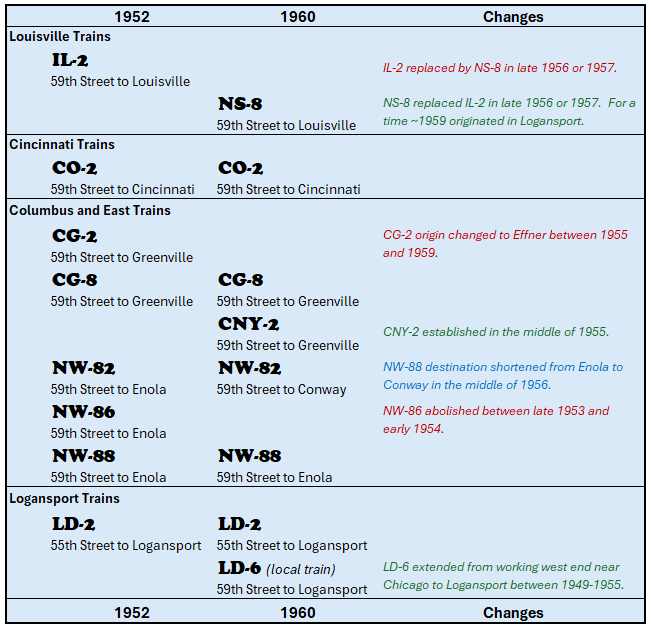
The success of CG-8 soon brought another additional train to handle the new business. Around the summer of 1951, CG-2 began operating also between 59th Street and Greenville. These were busy times on the Panhandle. The once hot merchandise traffic was declining, as evidenced by CO-2 originating at 59th Street instead of the Polk Street freight house, but perishable traffic was more than replacing it. Including the lowly LD-2, eight eastbound trains were scheduled out of Chicago on the Panhandle. However, around the beginning of 1954, NW-86 would disappear from the schedule, no doubt a victim of the new trains handling some of its traffic.
In the early 1950’s, it appears the Pennsy was concentrating most Chicago area traffic for the Panhandle at 59th Street and classifying it there. Notes on the schedule pages indicate traffic from Colehour was handled to 59th Street by shifter. CO-2 now originated at 59th Street instead of downtown. The exception was apparently IHB and Dolton traffic; virtually all trains were scheduled to pick up at Dolton. Concentrating everything at 59th Street simplified operations down the line, but these were probably challenging days at 59th Street performing this much classification.
TrucTrain Service begins
In the mid 1950’s, the Pennsylvania began handling trailers on flat cars (for details, check out Jerry Britton’s excellent timeline here.) Significant for the Panhandle eastbounds was the establishment of Chicago to Cincinnati service on March 1st, 1955 and overnight Chicago to Louisville service on June 15, 1955.
How this overnight traffic to Louisville and Indianapolis was handled is not entirely clear. IL-2 was scheduled for a 5:30pm departure from 59th street, so perhaps the cut off time for trailers was earlier for Indy and Louisville traffic. Hot CG-8 handled the rest of the TrucTrain traffic for the Panhandle and departing 59th Street at 8:30, allowing a 5:00 pm cutoff time for the day’s loading. IL-2 became NS-8 in late 1956 or 1957; I suspect this was a marketing move for the increased focus on TOFC traffic, but have no confirmation of this. By 1959, NS-8 was originating in Logansport a couple hours after CG-8 arrived, probably with the Indy and Louisville trailers for NS-8. This would be short lived as by the fall, NS-8 would again depart Chicago, this time with a 10:00pm departure.
Probably as a result of CG-8 handling new TrucTrain traffic, CNY-2 began operation from 59th Street to Greenville in the middle of 1955. At this point 59th Street was originating three daily trains for Greenville, quite the change from less than 10 years previous when there were none. But this would be short lived; soon CG-2 would be shifted to originate at the Effner gateway for several years to improve handling of TP&W traffic.
Mark Bej’s 1960 Freight Schedule depicts the daily TrucTrain operations at this time. Trailers would be loaded until 5:00pm each day at 47th Street in Chicago; a mere 15 minutes later, a shifter took the loaded flatcars to 59th Street. Outbound freight merchandise from Polk Street was also delivered to 59th street each afternoon. It was then up to 59th Street to sort this traffic and build CG-8 for an 8:30 departure followed closely by NS-8’s 10:00pm departure. I imagine the evening yardmaster’s blood pressure levels probably reflected this stress!
Into the Space Era…and the Penn Central
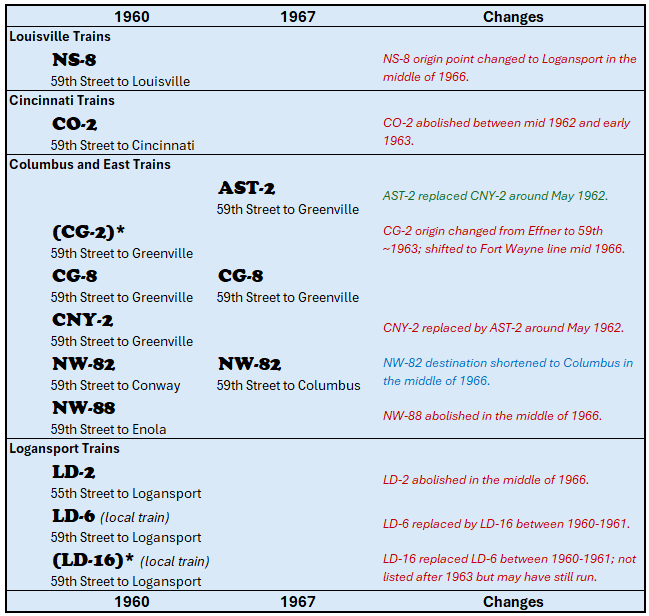
On February 20, 1962, John Glenn orbited the earth. This event unexpectedly affected the Panhandle eastbounds; a few months later CNY-2 disappeared, replaced by AST-2 (“Astronaut”), a marketing attempt to capitalize on this event. Unfortunately, this change unknowingly symbolized a change of eras; the glory days of the Pennsy Panhandle were ending.
Traffic remained stable for the first years of the 1960s but then began to drop. Late 1962 or early 1963, CO-2 was abolished; CO-8, a Logansport to Cincinnati train would now handle CO-2’s traffic. But the axe really fell around the summer of 1966. CG-2 was shifted to the Fort Wayne, NW-88 and LD-2 were abolished, and NS-8 was cut back to originate at Logansport instead of Chicago. Suddenly, not counting LD-6 which may or may not have still run, the Panhandle hosted only three scheduled eastbounds. This is how things remained until the Penn Central merger in February 1968. Adding insult to injury, Penn Central immediately shifted CG-8 to the Fort Wayne, and AST-2 began originating in Logansport. NW-82 was all that remained, and the Pennsylvania Railroad was gone.
The story continues into the Penn Central era in Panhandle Eastbound from Chicago Pt. 2.
Special thanks to Bert Zajac for the inspiration for this project, Rob Schoenberg’s Pennsylvania Employee Timetable Page, and all of the other people who have shared information; without them this would have been impossible.
 Moving the Freight