
This continues the Panhandle Eastbounds from Chicago covering the Pennsylvania Railroad era.

Penn Central: A New Era Begins
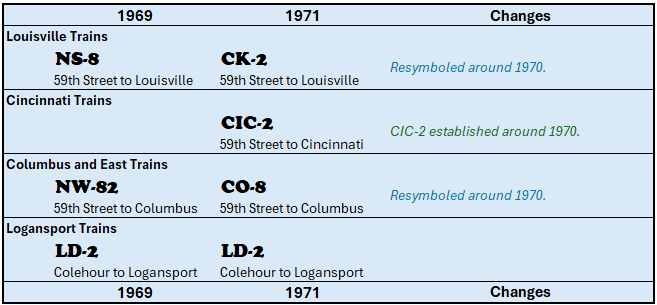
At the dawn of Penn Central, NW-82 was the only eastbound symbol freight operating on the Panhandle. Thankfully, things improved somewhat. NS-8 was restored to originate at 59th Street instead of Logansport once more, and LD-2 from Colehour resumed operating.
Pennsylvania Symbols Disappear
Sometime around 1970, the Penn Central got serious about integrating operations between the former New York Central and Pennsylvania in northwestern Indiana. As part of these changes, the Pennsy symbol system that had been in use for half a century disappeared, and new symbols established.
The Panhandle survived this first consolidation. The former NYC between Indianapolis and Chicago ceased to be used as a through route as former NYC trains SY-2 and CC-3 between those points were abolished. CK-2 (Chicago to Kentucky?) from 59th Street to Louisville replaced NS-8. While nominally a Louisville train, it carried only a block for the former NYC Avon Yard in Indianapolis where the train was entirely reclassified.
The longtime Chicago to Cincinnati train CO-8 survived in symbol form, but not in function. It became a 59th Street to Columbus train, replacing NW-82. It is unknown whether this perversion of history was intended or accidental. Taking its place in the Chicago to Cincinnati corridor was new symbol CIC-2, also originating at 59th Street. LD-2 stoically carried on, still a Colehour to Logansport train. For a brief time, operations looked a lot like the Pennsy by a different name. Each train picked up traffic for its respective destination at Dolton, while LD-2 set out blocks at Hartsdale to be picked up by the others.

IHB Dolton Pickups End
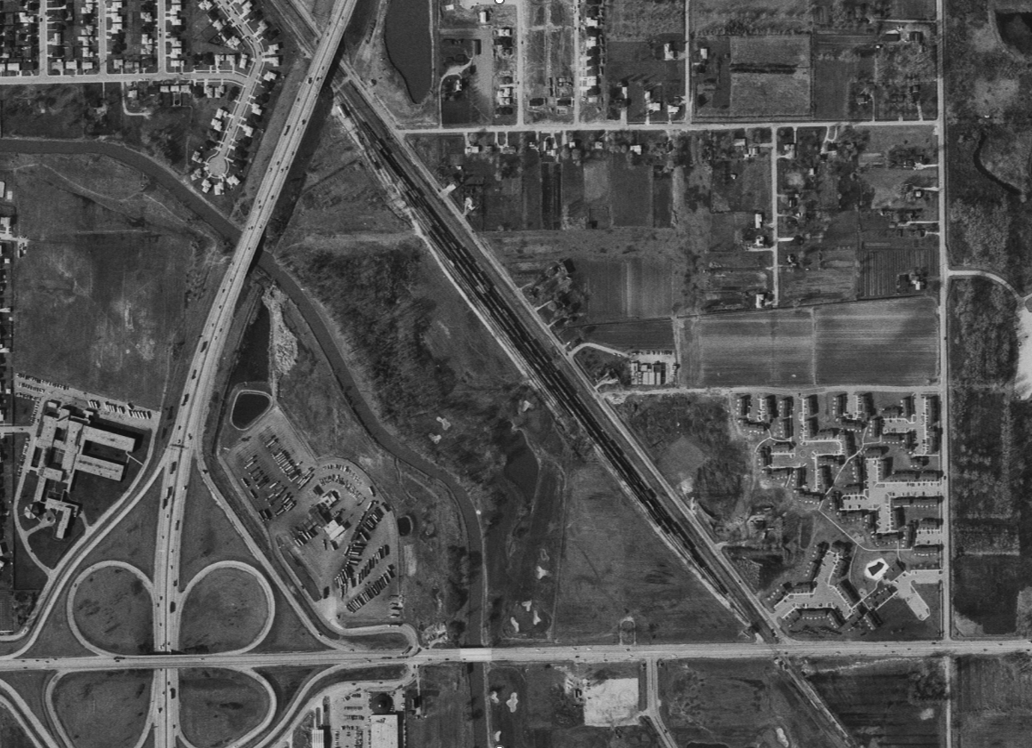
By the Spring of 1972, CK-2 was shifted to originate at Indiana Harbor Belt’s Blue Island Yard from 59th Street, carrying blocks Cincinnati, Columbus, and Avon. The Cincinnati and Columbus blocks were then set out at Hartsdale for the other trains to pick up, while CK-2 picked up the Avon traffic from 59th Street at North Judson set out by CO-8.
This greatly reduced Dolton Yard’s role. While I’m not sure if the IHB had delivered cars to Dolton preclassified or if they were classified at Dolton, shifting CK-2 to Blue Island allowed the elimination of at least one transfer job and the need to maintain Dolton Yard.
Logansport No Longer
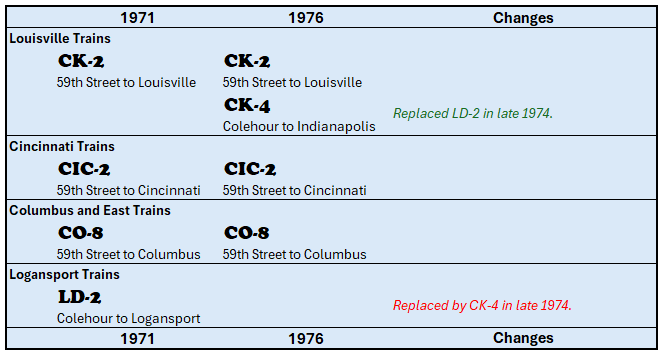
In the second half of 1974 (possibly around December), Logansport’s much diminished role was eliminated entirely. None of the trains carried blocks for Logansport. Longtime LD-2 from Colehour to Logansport became CK-4 from Colehour to Indianapolis. Colehour and 59th Street both began building Marion, IN blocks, bypassing Logansport which used to classify this traffic. All that remained was a Marion block swap between CK-4 and CIC-2, and CK-4 picked up whatever local traffic there was for Avon Yard.
Further Cuts…and a Reprieve
Around the beginning of the summer of 1975, 59th Street took its turn on the chopping block. CIC-2, the 59th Street to Cincinnati train was moved to originate at Elkhart. CO-8, the 59th Street to Columbus train, was abolished. 59th Street no longer maintained blocks for Cincinnati or Columbus. With these changes, CK-4 began originating at 59th Street instead of Colehour, then picking up at Colehour enroute to Avon. At this point IHB’s Blue Island yard was much more important than 59th Street, as it was becoming mostly a local support yard.
However, this plan must not have worked as well as hoped. A few months later in November 1975, the previous operating plan was restored. CIC-2 once again originated at 59th Street, CO-8 was reinstated, and CK-4 shifted back to Colehour. In yet another nod to past ways, Marion traffic moved once again via Logansport and blocks for Logansport were built at 59th Street and Colehour. All was not lost yet… but Conrail’s coming loomed ominously on the horizon.
The story finishes in the Conrail era in Panhandle Eastbound from Chicago Pt. 3.
 Moving the Freight